“Blessed and holy is he that hath part in the first resurrection: on such the second death hath no power, but they shall be priests of God and of Christ, and shall reign with him a thousand years.” Revelation 20:6 (KJV)
ABSTRACT
The dead rest unconsciously in the grave until the two resurrections at Christ’s return, when the righteous receive immortality and eternal life in the New Earth while spiritualism’s deceptions are forever exposed as Satan’s lie that man does not surely die.
THE DEAD: WHERE DO THEY REST TONIGHT?
The biblical doctrine of the unconscious state of the dead stands as one of the most liberating and prophetically urgent truths entrusted to the remnant people of God in these final hours of earth’s history. It dismantles the entire foundation of spiritualistic deception through which the adversary has drawn uncounted millions into communion with demonic counterfeits. To see the full tragic weight of that deception made visible in stone and timber, one need only consider the Winchester Mystery House in San Jose, California. That sprawling architectural fever dream consists of one hundred and sixty rooms, with staircases that terminate at ceilings and doors that open into forty-foot drops. Sarah Winchester raised it across four continuous decades, spending twenty million dollars on the project, convinced that the spirits of those killed by her family’s rifles required a never-ending labyrinth of construction to remain appeased. Her forty-year building project stands as the most fitting monument in American history to the foundational lie that the dead are not only conscious but urgently invested in the real estate of the living. Scripture answers that lie with absolute economy and devastating precision. The inspired Preacher declares without ambiguity: “For the living know that they shall die: but the dead know not any thing, neither have they any more a reward; for the memory of them is forgotten” (Ecclesiastes 9:5, KJV). Those plain and sacred words require no theological gymnastics to interpret. The dead know nothing. They feel nothing. They communicate nothing. They influence nothing in the affairs of the living. The psalmist confirms this truth with equal authority, writing: “His breath goeth forth, he returneth to his earth; in that very day his thoughts perish” (Psalm 146:4, KJV). The phrase “in that very day” is not a poetic approximation. It is a precise divine timestep marking the exact moment at which the interior life of the individual ceases its operation entirely. That cessation will not be reversed until the voice of the Son of God sounds across the corridors of every grave on this sin-wrecked earth on the morning of the first resurrection. The inspired pen of Ellen G. White illuminates this sacred verity with prophetic clarity: “Satan has power to bring before men the appearance of their departed friends. The counterfeit is perfect; the familiar look, the words, the tone, are reproduced with marvelous distinctness” (The Great Controversy, p. 552, 1911). That statement is not a concession to the reality of conscious post-mortem communication. Rather, the very perfection of the counterfeit is possible only because the dead themselves are utterly absent from every séance, every apparition, and every spiritualistic manifestation. The fallen angels have studied humanity across centuries and can replicate the biographical record of the departed with a fidelity that deceives those who are closest to the deceased. The inspired Preacher reinforces the comprehensive nature of death’s silencing: “Also their love, and their hatred, and their envy, is now perished; neither have they any more a portion for ever in any thing that is done under the sun” (Ecclesiastes 9:6, KJV). This verse strikes at the heart of the most emotionally powerful argument used to sustain belief in the continued activity of the dead. Many contend that the love of the departed is too strong to be extinguished. The word of God answers that love, hatred, and envy alike have perished at death. They have not been sublimated into a higher spiritual frequency. They have not been translated into angelic watchfulness over surviving relatives. They have perished entirely, as thoroughly and as completely as the breath that departed in the final moment of life. When the great Spirit of Prophecy addresses whether God receives anything from the dead, she speaks with the directness of a prophet: “Spiritualism is the masterpiece of deception that Satan employs to accomplish his purposes. It is Satan’s most successful and fascinating delusion” (The Great Controversy, p. 553, 1911). The theological weight of that sentence becomes fully visible when it is placed alongside the psalmist’s declaration: “The dead praise not the Lord, neither any that go down into silence” (Psalm 115:17, KJV). If the dead praised God from a conscious realm, if they communicated with the living, if they hovered as guardian angels over their descendants, then the spiritualistic systems claiming to channel them would have some foundation in spiritual reality. The psalmist categorically denies that foundation. Every apparition, every near-death tunnel of light, and every claimed communication from the departed must therefore be understood as the manufacture of a being who is neither dead nor honest — the adversary himself, working through his confederacy of fallen angels to exploit the natural human grief that follows bereavement. Ellen G. White deepens this doctrinal landscape when she writes: “The Saviour wept at the grave of Lazarus. He looked upon the misery brought by sin, and His heart was wrung with anguish. He came to give life to the world; He is the resurrection and the life” (The Desire of Ages, p. 786, 1898). That passage draws a direct line between the Saviour’s sorrow over death, His mission to undo it, and the resurrection as the singular divinely authorized mechanism through which that undoing will be accomplished. The undoing of death will not come through séance, not through reincarnation, and not through the continuation of a disembodied soul. It will come through the creative re-gathering of what was scattered in the grave at the moment the trumpet sounds and the Life-giver calls. The psalmist confirms the total silence of the grave when he asks: “For in death there is no remembrance of thee: in the grave who shall give thee thanks?” (Psalm 6:5, KJV). That rhetorical question invites the reader to feel the full weight of its implied answer. No one gives thanks from the grave. The remembrance of God, the thanksgiving of the creature, and the consciousness of time and relationship all vanish simultaneously with the departing breath. Ellen G. White turns to the foundational anthropology that explains why this is so: “Man was to be clothed with dignity befitting his position. The image of God, in which he was made, was to be seen in his noble bearing, in the beauty of his countenance, and in his upright form. He was to stand on the earth as the representative and the lord of creation, bearing in his own nature the image of his Creator” (Patriarchs and Prophets, p. 45, 1890). That passage establishes that the dignity of the human being is constituted by his proper dependent relationship to the Source of all life. Man’s exaltation depends entirely on his connection to the God who breathed into him the breath of life. When that breath returns to God at death, what remains is the dust. The dust does not think. It does not remember. It does not praise. It waits, sealed in the archive of the grave, for the appointed morning when the Creator will exercise again the same power He exercised in the garden of Eden. The Preacher states the dissolution plainly: “The dust shall return to the earth as it was: and the spirit shall return unto God who gave it” (Ecclesiastes 12:7, KJV). The spirit that returns to God is not a conscious personality continuing its existence in a disembodied realm. It is the animating life-principle — the divine breath — returning to its Source while the encoded identity of the individual waits in the sealed silence of the grave. Ellen G. White seals this understanding with the authority of her prophetic office: “The theory of the immortality of the soul was one of those false doctrines that Rome, borrowing from paganism, incorporated into the religion of Christendom. Martin Luther classed it with the ‘monstrous fables that form part of the Roman dunghill of decretals.’ Commenting on the words of Solomon in Ecclesiastes, that the dead know not anything, the Reformer says: ‘Another place proving that the dead have no…feeling. There is, saith he, no duty, no science, no knowledge, no wisdom there. Solomon judgeth that the dead are asleep, and feel nothing at all. For the dead lie there, accounting neither days nor years, but when they are awakened, they shall seem to have slept scarce one minute’” (The Great Controversy, p. 549, 1911). That patristic and Reformation corroboration elevates the doctrine of the unconscious state of the dead from a peculiar sectarian position into the historic consensus of those who have read the Scriptures most carefully and with fewest philosophical presuppositions. The Winchester Mystery House still stands today as a tourist attraction. Millions visit it each year, culturally conditioned to believe in a haunted world. Its labyrinthine futility and architectural absurdity declare, in every winding staircase and blocked doorway, the bankruptcy of every system of thought built upon the lie that the dead are conscious and mobile. That tragic monument invites every thoughtful soul to turn from the winding staircases of tradition and fear to the straight and clear corridor of the prophetic word. There, the resurrection morning waits at the end of the night of death — certain, near, and guaranteed by the One who is Himself the Resurrection and the Life. The dead do not walk. They sleep. They will awaken only when the appointed voice calls them forth into the eternal morning of God’s unending kingdom.
LUCIFER FELL: WHO FIRST TOLD THAT LIE?
To trace the doctrine of the immortality of the soul to its headwaters, one must travel not to the academies of Athens or the mystery schools of Babylon, though those streams are genuine tributaries, but to the very courts of heaven before sin had yet stained the universe. There, a being of transcendent beauty, singular intelligence, and vast created authority first chose to allow the heat of self-adoration to corrupt the wisdom with which he had been endowed. In that moment of interior surrender to pride, he introduced into the universe the principle that would become the engine of every subsequent deception, including the deception about the conscious dead. The lie that man shall not surely die proceeds from the same root disposition that whispered in Lucifer’s heart the declaration: “I will be like the most High.” The prophet Isaiah tears aside the veil of history to reveal the anatomy of this primordial fall: “How art thou fallen from heaven, O Lucifer, son of the morning! how art thou cut down to the ground, which didst weaken the nations!” (Isaiah 14:12, KJV). The grief embedded in that exclamation — “How art thou fallen!” — is not merely rhetorical lamentation. It is the sacred record of the catastrophe that set the entire tragic course of cosmic history into motion. From that single moment, every subsequent deception, every war, every grave, every grieving family gathered around a coffin, and every spiritualistic séance finds its ultimate origin. The prophet does not leave the mechanism of the fall to speculation. He reports the interior monologue of the fallen cherub with stunning precision: “For thou hast said in thine heart, I will ascend into heaven, I will exalt my throne above the stars of God” (Isaiah 14:13, KJV). The catastrophe began not with an external act but with a privately cherished thought. Lucifer entertained the conviction that his position, glory, and authority were insufficient. He believed the worship properly flowing toward the Creator ought to be redirected toward himself. This fundamental inversion of the direction of worship is the theological root from which the lie of the immortal soul springs. When the creature places himself in the position of the Creator, the logical consequence is that the creature assigns to himself the one attribute that belongs to God alone — namely, inherent, underived, and inextinguishable life. Ellen G. White illuminates this catastrophic interior development with prophetic clarity: “Little by little Lucifer came to indulge the desire for self-exaltation. The Scripture says, ‘Thine heart was lifted up because of thy beauty, thou hast corrupted thy wisdom by reason of thy brightness.’ Ezekiel 28:17. Lucifer had been the wisest of created beings and highest in power and glory; but leading away from God, he had corrupted his wisdom. He declared that he would no longer be content to be second in honor, that he would no longer be overshadowed by the glory of Christ” (Patriarchs and Prophets, p. 35, 1890). That passage reveals the specific sequence of events within the fallen being’s interior life. Beauty became vanity. Vanity became ambition. Ambition became open rebellion against the throne of God. Rebellion gave birth to the lie that would echo from Eden to Endor to the present moment. The prophet records the climactic declaration of Lucifer’s ambition in words that carry the full weight of theological catastrophe: “I will ascend above the heights of the clouds; I will be like the most High” (Isaiah 14:14, KJV). That declaration is not merely a historical ambition. It is the theological statement that constitutes the foundation of every false religion ever devised. The desire to possess the attributes of the Most High without submission to the Most High is the desire that produces the doctrine of the immortal soul. It is the desire that tells humanity that man possesses within himself an indestructible life-principle that cannot be extinguished even by the judgment of the Creator. Ellen G. White connects that primordial rebellion directly to the present deceptions about the dead: “Satan had power to bring before men the appearance of their departed friends and to counterfeit their appearance so perfectly that they will be received as genuine. The great deceiver will make it appear that the dead are alive, and that they are returning with messages of hope and encouragement to those who are left behind” (The Great Controversy, p. 552, 1911). That statement must be understood in full theological context. The fallen being who manufactures these counterfeits is the same being who once stood in the presence of God. He chose in a moment of self-corrupting brilliance to redirect toward himself the worship that belongs only to the Source of all life. Every counterfeit apparition of a deceased relative is therefore not merely a psychological manipulation. It is an act of cosmic usurpation, an attempt to stand in the place of God by controlling the narrative of death and what lies beyond it. The divine sentence falls with unwavering certainty: “Yet thou shalt be brought down to hell, to the sides of the pit” (Isaiah 14:15, KJV). That divine reversal of the self-exalting trajectory is the guarantee that every deception currently working through spiritualistic channels will not achieve its ultimate purpose. The counterfeit will be exposed. The manufacturer of the counterfeit will be destroyed. In the meantime, however, the deceptions are real, they are effective, and they are accelerating in cultural penetration and spiritual sophistication. The prophet Ezekiel adds texture to Isaiah’s account when he describes the original station of the one who fell: “Thou wast perfect in thy ways from the day that thou wast created, till iniquity was found in thee” (Ezekiel 28:15, KJV). The word “perfect” here is not hyperbolic. It describes an actual state of moral and spiritual integrity that was real and constitutive of Lucifer’s original being. That perfection was destroyed not by any external force or arbitrary divine act but by the inward cultivation of a disposition that chose self over God. This means that the capacity for perfect created existence — including life in dependence upon the Creator rather than life as a self-possessed attribute — is not an insult to creaturely dignity but the very framework within which genuine flourishing was always possible. Ellen G. White opens the heavenly record further when she writes: “When God said to His Son, ‘Let us make man in our image,’ Satan was jealous of Jesus. He wished to be consulted concerning the formation of man, and because he was not, he was filled with envy, jealousy, and hatred. He desired to receive the highest honors in heaven next to God” (The Desire of Ages, p. 118, 1898). The adversary’s animosity toward the human race is therefore not incidental but structural. It is rooted in the jealousy that preceded our creation and intensifies through every subsequent act of divine redemption. This is why the deceptions the adversary engineers are specifically calibrated to exploit the most tender human vulnerabilities, including the grief of bereavement. The prophet continues his description of the original greatness of the one who fell: “Thou art the anointed cherub that covereth; and I have set thee so: thou wast upon the holy mountain of God” (Ezekiel 28:14, KJV). The office of the anointed covering cherub placed Lucifer in the closest possible proximity to the divine presence. He was the most highly positioned created being in the universe. His subsequent fall was therefore not merely a personal tragedy. It was a theological cataclysm. The being who stood closest to the Source of all life and truth chose to become the primary distributor of death’s lie across the breadth of human history. Ellen G. White traces the first utterance of that lie to its precise historical moment: “It was by deception that Satan gained control of the human race. Not by an open, frank avowal of his hatred of God, but by insinuating doubts of God’s wisdom and justice. He would lead men to question God’s word” (The Great Controversy, p. 531, 1911). That statement connects the lie spoken in Eden — “Ye shall not surely die” — directly to the program of doubt that began in the courts of heaven. The immortality-of-the-soul doctrine is not a benign philosophical disagreement with biblical anthropology. It is a continuation of the original heavenly rebellion, carried forward through human history by the same intelligence that first devised it. The prophet Isaiah delivers the full indictment of the one who “made the world as a wilderness, and destroyed the cities thereof; that opened not the house of his prisoners” (Isaiah 14:17, KJV). That sweeping description points forward to the panoramic devastation that has followed the Eden lie. Every grave on this planet, every civilization that collapsed under the weight of its own spiritual corruption, and every human being demoralized by the deception of conscious communion with the dead is part of the collateral damage of that original self-exalting declaration made in the courts of heaven. Ellen G. White reinforces the cosmological stakes of this conflict: “From the very beginning of the great controversy, it has been Satan’s purpose to misrepresent God’s character and to excite rebellion against His law, and God has been working to reveal His character of love and to vindicate the principles of His law” (The Great Controversy, p. 494, 1911). The entire history of spiritualistic deception is not a series of isolated occurrences. It is a sequence of episodes in a single vast cosmic drama whose resolution is certain, whose timeline is prophetically marked, and whose outcome is the final and irreversible vindication of the divine character and the divine law. Those who have learned to trace the lie about the immortal soul back to its origin in Lucifer’s throne-room ambition possess a clarity that no cultural pressure, no supernatural manifestation, and no emotionally compelling counterfeit can ultimately override. They have seen the source of the deception. They know the character of the deceiver. They stand upon the immutable word of the One who holds still the keys of death and the grave. On the appointed morning, those keys will open every sealed tomb, and the sleeping saints will arise to vindicate the God who formed them from dust and who refused to let the grave have the final word.
ENDOR’S DARK SECRET: WAS IT SAMUEL?
The midnight journey of King Saul to the cave of the woman at Endor stands in the sacred record as one of the most solemnly instructive narratives in the entire corpus of Scripture. It is a case study in the progressive consequences of spiritual apostasy, the lethal danger of consulting forbidden channels in moments of crisis, and the devastating effectiveness of demonic deception when a soul has severed its connection from the word and the Spirit of the living God. The story of Saul does not begin at Endor. It reaches back through years of self-centered decision-making, prophetic disobedience, and violent jealousy. The king had systematically dismantled every bridge between himself and his Creator. The night came when the Philistines gathered for a final, decisive battle. Saul stood in a vacuum of absolute divine silence from which there was no natural exit. The sacred record states with terrible simplicity: “And when Saul saw the host of the Philistines, he was afraid, and his heart greatly trembled” (1 Samuel 28:5, KJV). The phrase “his heart greatly trembled” is the spiritual biography of every soul that has wandered systematically away from the guiding presence of God. The trembling of Saul’s heart in that moment was not the healthy fear that drives the repentant to the mercy seat. It was the hollow panic of a man who had consumed all the resources of divine grace available to him and was confronting the darkness entirely on his own terms. God’s response to the king’s desperate inquiry is recorded with equal economy: “And when Saul inquired of the Lord, the Lord answered him not, neither by dreams, nor by Urim, nor by prophets” (1 Samuel 28:6, KJV). The triple listing of the channels through which divine communication ordinarily flows — dreams, Urim, prophets — underscores the comprehensiveness of the divine silence. God was not being capricious or neglectful. The silence was the structural consequence of Saul’s own choices. His accumulated rebellion had choked every conduit through which the heavenly voice might otherwise have reached him. Instead of reading that silence as a call to desperate, unconditional repentance, Saul read it as a logistical problem requiring an alternative information source. The record states: “Then said Saul unto his servants, Seek me a woman that hath a familiar spirit, that I may go to her, and inquire of her” (1 Samuel 28:7, KJV). The casual pragmatism of that sentence is the most chilling element of the entire account. The king who had once, in a better hour, expelled every medium and diviner from the land now sends servants to find one as he might send them to find a physician or a military advisor. The boundary between the permitted and the forbidden had dissolved entirely in the solvent of his desperation. Ellen G. White addresses the theological impossibility that the apparition could have been Samuel: “Saul had been disobedient and rebellious, and the Lord had departed from him, and would not answer him by dreams, nor by Urim, nor by prophets. Saul desired Samuel to come to his aid, but God does not work contrary to His own principles. He had refused to answer Saul through the prophets. He certainly would not communicate with him through a familiar spirit” (Patriarchs and Prophets, p. 681, 1890). God, who had declared through His own law that consulting familiar spirits is an abomination, would not violate His own principles to answer through that condemned channel the very king whose disobedience had severed the prophetic line of communication. The psalmist’s testimony reinforces the theological argument from a different direction: “For the grave cannot praise thee, death can not celebrate thee: they that go down into the pit cannot hope for thy truth” (Isaiah 38:18, KJV). If they who go down into the pit cannot hope for God’s truth, still less can they deliver it through the agency of a medium. Whatever the apparition communicated at Endor, its source was not the grave of Ramah but the councils of the adversary. The adversary had studied Samuel’s biography, his mannerisms, his prophetic vocabulary, and his relationship to Saul. He was fully prepared to deploy all that accumulated knowledge in a perfectly calibrated deception designed to drive Saul into final despair. Ellen G. White confirms the identity of the deceptive agent: “It was not God’s holy prophet that came forth at the spell of a sorceress. Samuel was not present in that haunt of evil spirits. That night’s interview was not a conversation with the dead Samuel, but a masterpiece of deception” (Patriarchs and Prophets, p. 681, 1890). The phrase “masterpiece of deception” echoes the larger description of spiritualism in The Great Controversy. The Endor incident is not an isolated exception to the rule that the dead know nothing. It is the paradigmatic case study that reveals exactly how the deception works in every generation. The fallen angels possess intimate knowledge of the departed. They deploy that knowledge through whatever vulnerable channel presents itself. They deliver messages designed to demoralize the living and direct them away from the God of Scripture toward the authority of the counterfeit communication. The psalmist adds to the indictment of the dead’s powerlessness: “I am counted with them that go down into the pit: I am as a man that hath no strength” (Psalm 88:4, KJV). The dead go down into the pit. They are beyond the reach of familiar spirits. They are beyond any capacity to ascend at the command of a medium. They wait in the unconscious archive of the grave for the morning of the first resurrection. This is precisely why the apparition at Endor had to be something other than Samuel. Samuel was not in a conscious realm accessible to mediums. He was in the pit — silent, sealed, and waiting for the Life-giver’s call. The woman of Endor presents the unfolding apparition to the terrified king: “And he said unto her, What form is he of? And she said, An old man cometh up; and he is covered with a mantle” (1 Samuel 28:14, KJV). The specificity of the description — old man, covered with a mantle — demonstrates the level of biographical and visual detail with which the demonic counterfeit was executed. That level of biographical specificity is precisely what makes the deception so effective. It is also precisely what the Spirit of Prophecy identifies as the mark of demonic rather than divine communication. Ellen G. White warns that this deceptive sophistication has not diminished but increased across the centuries: “The counterfeit is perfect; the familiar look, the words, the tone, are reproduced with marvelous distinctness” (The Great Controversy, p. 552, 1911). The perfection of the counterfeit is not evidence of the genuine presence of the dead. It is evidence of the vast intelligence and centuries of accumulated biographical study possessed by the fallen angels who manufacture the deception. The psalmist continues his description of the condition of the dead: “Free among the dead, like the slain that lie in the grave, whom thou rememberest no more: and they are cut off from thy hand” (Psalm 88:5, KJV). That phrase “cut off from thy hand” describes the complete absence of the dead from every sphere of active divine service. The dead cannot serve God. They cannot communicate truth. They cannot intercede for the living. They are cut off from the hand of the living God until the hand of that same God reaches into the sealed archives of the grave on the resurrection morning and calls them back to life. Ellen G. White draws the legislative and spiritual conclusion from the Endor episode: “The act of Saul in consulting a sorceress is cited in Scripture as one reason for his rejection by God. There is an account given by the inspired historian, ‘So Saul died for his transgression which he committed against the Lord, even against the word of the Lord, which he kept not, and also for asking counsel of one that had a familiar spirit, to inquire of it’” (Education, p. 240, 1903). That divine indictment removes any possibility that consulting spiritualistic channels is a spiritually neutral act. It is a transgression against the word of the Lord, as serious in the sight of heaven as the disobedience that initially severed Saul’s prophetic connection. The story of Endor is not merely ancient Israelite history. It is a living pastoral warning for every soul who, in a moment of grief or curiosity, is tempted to seek from forbidden channels what can only be legitimately received from the word of the living God and the ministry of the Holy Spirit. Ellen G. White further characterizes the theological trajectory of spiritualistic teaching: “Spiritualism asserts that men are unfallen demigods, that ‘each mind will judge itself,’ that ‘true knowledge places men above all law,’ that ‘all sins committed are innocent,’ for ‘whatever is, is right,’ and ‘God doth not condemn’” (The Great Controversy, p. 588, 1911). The theological conclusions toward which the Endor encounter points — conclusions articulated today with increasing sophistication through every medium of popular spirituality — constitute an organized program of antinomianism. They are designed to dissolve the moral law and eliminate the investigative judgment from human consciousness. They clear the way for the final deception in which the adversary himself will appear to the world as the returning Christ. The woman of Endor and the shattered figure of Saul prostrate before the counterfeit apparition in her cave together constitute the Bible’s most vivid portrait of the ultimate consequence of trading the living word of God for the whispered counsel of the dead. Their story is preserved in the sacred record not as a curiosity of Israelite history but as a mirror. Every generation is invited to recognize its own danger within it. Having recognized it, every generation is called to turn with fresh resolve toward the One who alone has the words of eternal life and who will, on the appointed morning, call every sleeping saint by name.
DUST TO DUST: WHAT IS MAN, TRULY?
The question of what a human being actually is — not as philosophy frames it but as Scripture defines it — carries consequences so far-reaching that a wrong answer here compromises everything that follows in biblical theology. If man is by nature an immortal soul temporarily housed in a mortal body, then the entire biblical argument against spiritualism collapses. The death-lie of Eden becomes a partial truth. The Platonic dualism imported into Christianity from the academies of Greece is vindicated against the testimony of the Hebrew prophets and apostles. But if man is what the Bible declares him to be — a mortal, unified creation possessing no inherent immortality and no separable conscious soul — then the entire edifice of spiritualistic deception is exposed as the lie it is. The resurrection morning is restored to its place as the singular hope of the believing community. The Genesis account provides the foundational anthropological statement from which all subsequent biblical anthropology proceeds: “And the Lord God formed man of the dust of the ground, and breathed into his nostrils the breath of life; and man became a living soul” (Genesis 2:7, KJV). The precise grammatical structure of that sentence carries the highest theological significance. The divine creative act is followed by the resulting state. A human being is not an immortal soul living inside a body of dust. Man is, in his unified totality, a living soul — the product of the combination of the divine breath with the material substance of the earth. When that combination is dissolved by death, the living soul is dissolved along with it, just as surely as a mathematical product is dissolved when one of its factors is removed. Ellen G. White illuminates the intended dignity of this created constitution: “Man was to be clothed with dignity befitting his position. The image of God, in which he was made, was to be seen in his noble bearing, in the beauty of his countenance, and in his upright form. He was to stand on the earth as the representative and the lord of creation, bearing in his own nature the image of his Creator” (Patriarchs and Prophets, p. 45, 1890). The dignity of the human being is not undermined by the anthropology of Genesis 2:7. It is constituted by it. A being formed from dust and animated by the divine breath, created to bear the image of God across the created order, is not a diminished being. The exaltation of such a being depends entirely upon his proper relational dependence on the Source of the breath that makes him a living soul. The Creator’s verdict upon the consequence of sin confirms the anthropological framework with the symmetry of a divine verdict: “In the sweat of thy face shalt thou eat bread, till thou return unto the ground; for out of it wast thou taken: for dust thou art, and unto dust shalt thou return” (Genesis 3:19, KJV). The symmetry of that declaration — dust you came from, to dust you shall return — is not merely poetic. It is structurally revelatory. The direction of travel at death is downward and backward, returning to the constituent materials from which the living soul was made. It is not upward and forward into a disembodied conscious realm where personality continues without its material component. Ellen G. White confirms the comprehensive nature of this dissolution: “Man is mortal, and through disobedience he has forfeited the divine favor and the right to life which God had granted him. Left to himself, man can do nothing to regain what has been lost. His condition is hopeless. He can look forward to nothing but misery and death” (Education, p. 253, 1903). Man is mortal in his very being. No amount of spiritualistic theory can elevate him out of that mortality. The only power capable of reversing it is the creative and redemptive power of the God who made him and who will remake him on the resurrection morning. The Preacher of Ecclesiastes surveys the shared destiny of all living creatures and draws a conclusion that strips the doctrine of natural immortality of every philosophical pretension: “For that which befalleth the sons of men befalleth beasts; even one thing befalleth them: as the one dieth, so dieth the other” (Ecclesiastes 3:19, KJV). That parallel is not an insult to human dignity. It is an argument against the notion of inherent immortality. If men possessed a naturally immortal soul that beasts did not, the manner of their dying would necessarily differ. The inspired observer notes that the same death comes to both. The unique dignity of the human being is therefore not located in a naturally immortal component. It is located in the divine image he bore in life and will bear again in resurrection glory when the Creator exercises His redeeming authority. The Preacher continues his observation to its logical conclusion: “All go unto one place; all are of the dust, and all turn to dust again” (Ecclesiastes 3:20, KJV). The “one place” to which all go is not a theological claim about the equality of all moral outcomes. It is an anatomical observation about the shared destination of the material component of every living creature. All return to the constituent dust from which they were formed. All await what only God can do — call them back into being on the morning of the resurrection. Ellen G. White places this truth within the framework of the great controversy: “In the sixth century before Christ, the prophet Daniel showed that the dead are to continue in an unconscious state until the resurrection. ‘Many of them that sleep in the dust of the earth shall awake, some to everlasting life, and some to shame and everlasting contempt.’ And the Saviour Himself declared: ‘The hour is coming, in the which all that are in the graves shall hear His voice, and shall come forth’” (The Great Controversy, p. 549, 1911). The resurrection language itself confirms the unconscious state of the dead. A person who is consciously alive in heaven does not need to be raised from a grave. Resurrection only makes sense if the person is genuinely and completely absent until the Life-giver calls. The inspired Preacher returns once more to the primary text: “Then shall the dust return to the earth as it was: and the spirit shall return unto God who gave it” (Ecclesiastes 12:7, KJV). The spirit that returns to God is the animating life-principle — the divine breath — not a conscious personality continuing its existence and activity in a spiritual realm. The dust remains in the grave. The breath returns to its Giver. And the living soul, which was the product of the combination of the two, ceases its existence as a conscious unit until the appointed morning of the resurrection. Ellen G. White addresses the Platonic alternative with the directness of a prophet who fully understands the stakes: “The doctrine of natural immortality, first borrowed from the pagan philosophy and under the disguise of Christian theology incorporated into the Christian faith, has supplanted the truth that ‘the dead know not anything.’ Multitudes have come to believe that it is the spirits of the dead who are the ‘familiar spirits’ forbidden in the Scriptures. But how can we account for the power of these spirits to foretell the future, to bring to light things hidden and far away, to personate the dead with such accuracy?” (The Great Controversy, p. 551, 1911). The question is rhetorical. The answer lies in the supernatural intelligence and centuries of accumulated knowledge possessed by the fallen angels who manufacture the deceptions, not in any genuine communication with the departed. The psalmist adds the perspective of one who has stared into the abyss of mortality: “What man is he that liveth, and shall not see death? shall he deliver his soul from the hand of the grave?” (Psalm 89:48, KJV). The rhetorical question carries its own devastating answer: no man delivers his soul from the hand of the grave through any inherent capacity of his own being. Deliverance from the grave comes only from the outside, only from the One who formed the first man from dust and who will form the last resurrected saint from the dust of ten thousand graves. Ellen G. White draws the full practical conclusion of the biblical anthropology for the community of faith: “God breathed into man’s nostrils the breath of life, and man became a living soul, partaking of the nature of God and yet being distinct from God. God gave man a character in which holiness was stamped, for man was created in the likeness of God” (The Desire of Ages, p. 787, 1898). The biblical anthropology of Genesis 2:7, confirmed by the Preacher of Ecclesiastes, enforced by the psalms, and illuminated by the Spirit of Prophecy, stands as the most impregnable fortification against spiritualistic deception available to the remnant community. When the truth that man is a living soul rather than a soul with a body is fully internalized and embraced, every counterfeit apparition of a deceased relative is instantly and permanently identified as the demonic fabrication it is. The grief that might otherwise make such fabrications appealing is redirected toward the genuinely scriptural, genuinely life-transforming hope of the resurrection morning — the morning toward which every sleeping saint in every sealed grave is moving through the unconscious timelessness of the death-sleep.
SLEEP OF DEATH: WHEN COMES MORNING?
Among all the scriptural metaphors employed to describe the state of the dead, none is more theologically freighted, more spiritually comforting, or more doctrinally precise than the metaphor of sleep. The choice of this particular image is not arbitrary or merely poetic. It carries within it a complete set of theological implications that directly contradict every significant claim made by spiritualistic systems about the condition of the departed. Sleep implies a cessation of activity. It implies a loss of awareness of the passage of time. Most crucially, it implies the anticipation of an awakening. The metaphor is therefore simultaneously a description of present reality and a prophetic promise of future restoration. When the inspired Preacher declares, “Whatsoever thy hand findeth to do, do it with thy might; for there is no work, nor device, nor knowledge, nor wisdom, in the grave, whither thou goest” (Ecclesiastes 9:10, KJV), he is not expressing pessimistic despair about the finality of death. He is framing, with the precision of a theologian, the absolute silence and cessation that characterize the sleep of death. No work. No device. No knowledge. No wisdom. None of the active, conscious, purposeful operations that characterize waking life are present in the grave. This comprehensive absence confirms the metaphor of sleep as the most accurate available description of the state of the dead. Ellen G. White takes up this metaphor and places it within the framework of the Saviour’s own teaching: “Jesus said to His disciples, ‘Our friend Lazarus sleepeth; but I go, that I may awake him out of sleep.’ This was a plain statement that Lazarus was dead. Christ was not speaking poetically. He was stating a literal truth. Lazarus was sleeping in the grave. To the Saviour, death was not death; it was sleep” (The Desire of Ages, p. 787, 1898). The significance of that last phrase — “To the Saviour, death was not death; it was sleep” — lies in what it implies about the reversibility of death. We do not speak of reversing sleep in ordinary language. We speak of waking someone from sleep. The choice of the sleeping metaphor by Christ Himself carries the implicit promise of a morning, an appointed moment of awakening. The sleeping saint moves toward that morning without awareness of the passage of time or the suffering of the intervening period. The inspired Preacher reinforces the comprehensive nature of the unconsciousness of the dead: “For the living know that they shall die: but the dead know not any thing” (Ecclesiastes 9:5, KJV). The stark contrast between the knowledge of the living and the ignorance of the dead defines the boundary between the two states with the clarity of a mathematical equation. On one side of that boundary stands the consciousness and moral awareness of the living creature. On the other side stands the total, unbroken, undisturbed silence of one who sleeps as completely as any person who has ever closed their eyes for the night. Ellen G. White deepens the consolation available in this metaphor: “The grave is a place of silence, but it is also a place of rest. To those who die in Christ, the grave is indeed a shelter and a resting place. They rest in peace from their labors” (The Great Controversy, p. 550, 1911). The word “rest” here is not euphemism. It is theological precision. The rest that the sleeping saints enjoy in their graves is a rest from the warfare, the suffering, the temptation, and the sorrow that constituted the waking experience of their earthly pilgrimage. That rest will be interrupted only at the most glorious possible moment, when the voice of the Life-giver sounds across the sleeping earth and calls them to arise in immortal glory. The connection between the truth about death and the institution of the Sabbath is one of the most theologically elegant dimensions of the remnant message. Both the Sabbath and the unconscious state of the dead point to the same foundational truth. Life, genuine and enduring life, comes from the Creator alone. The creature possesses no life in himself that is independent of the divine initiative. The law of God declares with regal authority: “Remember the sabbath day, to keep it holy” (Exodus 20:8, KJV). The invitation to remember is an invitation to reconnect with the foundational theological reality from which the Sabbath derives its meaning. The Creator made all things. He is the Source of all life. He blessed the seventh day and hallowed it as a sign of His creative authority. The weekly rest He enjoins upon His creatures is a participation in His own rest and an acknowledgment that all life flows from Him alone — including the life that sleeps in the grave and will be restored on the resurrection morning. Ellen G. White articulates the connection between the Sabbath and the resurrection with prophetic clarity: “The Sabbath and the resurrection are linked together in a wonderful way. As God rested on the seventh day, so the righteous sleep in the grave; as God arose to complete his work of creation, so shall the righteous arise at the last trump to enter upon a new creation” (Patriarchs and Prophets, p. 336, 1890). The typological line she draws between the Sabbath rest of the Creator and the sleep-rest of the creature in the grave is of great prophetic significance. The divine arising from rest to continue the work of creation is the type. The resurrection morning in which the dead in Christ shall arise to enter the new creation is the antitype. The Creator’s own testimony in the law reinforces this theological connection: “For in six days the Lord made heaven and earth, the sea, and all that in them is: and rested the seventh day: wherefore the Lord blessed the sabbath day, and hallowed it” (Exodus 20:11, KJV). The power that made heaven and earth and all that in them is — the power that formed man from the dust and breathed into him the breath of life — is the same power that will raise the sleeping saints from their graves. The weekly observance of the Sabbath is therefore not merely a memorial. It is an anticipation. It is a weekly rehearsal of the trust in the Creator’s life-giving power that will sustain the believer through the darkness of death toward the morning of the first resurrection. The connection between the rejection of the Sabbath truth and the embrace of spiritualistic theories about death is not coincidental. It is structural. Both the Sabbath and the doctrine of the unconscious dead point to the same Creator-creature boundary. Across that boundary, life and consciousness flow only from the Creator toward the creature, never from the creature upward as a self-sustaining possession. To deny the Sabbath is already to have moved philosophically toward the position that the creature is self-sustaining and possessed of a life that does not depend on the continued creative favor of God. Ellen G. White identifies this structural connection explicitly: “The rejection of the Sabbath truth often accompanies the acceptance of the error of the immortal soul. Both errors deny the sovereignty of God as Creator and Sustainer of life” (The Great Controversy, p. 588, 1911). That insight allows the remnant community to understand why the Sabbath controversy and the spiritualism controversy are not two separate doctrinal skirmishes. They are two theaters of the same great battle over the fundamental question of whether life and law originate with the Creator or with the creature. The psalmist adds the voice of liturgical worship to the theological argument: “The Lord reigneth; let the earth rejoice; let the multitude of isles be glad thereof” (Psalm 97:1, KJV). The reign of the Lord — the very sovereignty that is celebrated in Sabbath observance — is the same sovereignty that guarantees the resurrection morning. The God who reigns over the living creation also reigns over the sleeping dead. His reign extends into every sealed grave on this planet. No power of darkness, no familiar spirit, and no demonic impersonation of the departed can challenge that sovereign claim or gain one moment’s unauthorized access to the sealed archive of those who sleep in the Lord. Ellen G. White seals the comfort of the metaphor for every bereaved believer: “To the believer, death is but a sleep, a moment of silence and darkness. The life is hid with Christ in God, and ‘when Christ, who is our life, shall appear, then shall ye also appear with Him in glory’” (The Desire of Ages, p. 787, 1898). The life that is hid with Christ in God is not a conscious soul floating in a heavenly realm. It is the sealed promise of the resurrection — the divine record of the sleeping saint’s identity, kept with perfect fidelity by the One who knows every hair of every head and who will call each sleeping saint by name on the morning when the last trump sounds. The believer who understands the sleep of death, who has received the comfort and the protection that this truth provides, and who weekly observes the Sabbath as a memorial of the creative power that is also the resurrection power, stands in a position of extraordinary spiritual security. No counterfeit apparition of a deceased loved one can reach across the boundary that the word of God has established between the living and the dead. No grief can be exploited into a door of spiritualistic deception. The foundation of the remnant’s hope is not the imagined consciousness of the departed but the certain, scriptural, Sabbath-signposted morning of the resurrection — the morning that grows nearer with every Sabbath that passes and every prayer offered in the darkness before the dawn.
SCREEN GHOSTS: WHO PLANTED THAT SEED?
The deception of spiritualism has not remained confined to the darkened parlors of nineteenth-century mediums or the dramatic consultations recorded in the ancient prophetic histories. It has migrated with astonishing adaptive intelligence into the most pervasive channels of cultural formation available in the modern world. It has colonized the entertainment industry, the publishing industry, the academic disciplines of psychology and near-death research, and the popular spiritual vocabularies of millions of professing Christians. These individuals would recoil from a traditional séance, but they consume without theological scrutiny a steady diet of films, television programs, novels, and therapeutic frameworks that all presuppose and normalize communication with the dead. Through decades of media exposure, the doctrinal and cultural ground has been so thoroughly prepared that the final supernatural deceptions of the last days will meet almost no resistance from a population conditioned to regard the appearance of the dead as a natural and even comforting phenomenon. The apostle Paul, writing under prophetic inspiration about the spiritual climate of the last days, declares with striking precision: “Now the Spirit speaketh expressly, that in the latter times some shall depart from the faith, giving heed to seducing spirits, and doctrines of devils” (1 Timothy 4:1, KJV). The precision of that inspired forecast — “the Spirit speaketh expressly,” not obliquely, not inferentially, but with explicit directness — leaves no room for the comfortable suggestion that the apostle was speaking metaphorically. The seducing spirits and doctrines of devils he identifies as characteristic of the latter times are the same spiritual agents and false doctrines that operate through every iteration of spiritualistic deception, whether the medium of delivery is a darkened parlor or a high-definition streaming screen. The apostle continues: “Speaking lies in hypocrisy; having their conscience seared with a hot iron” (1 Timothy 4:2, KJV). The image of the seared conscience describes with clinical precision what happens when the capacity for doctrinal discernment is gradually eroded by accumulated cultural exposure to spiritualistic narratives. The conscience that once registered an alarm when confronted with the claim that the dead are conscious and communicating is, through steady entertainment exposure, progressively deadened. Eventually the alarm mechanism no longer functions. The deception is received as comforting truth rather than deadly lie. Ellen G. White anticipated the full scope of this cultural saturation: “Spiritualism, which numbers its converts by millions, has made its way into scientific circles, has invaded churches, and has found favor in legislative bodies, and even in the courts of kings. It is a power that is not to be lightly regarded” (The Great Controversy, p. 553, 1911). The legislative bodies and courts of kings she identified are paralleled in the present age by the streaming platforms, the box office charts, and the cultural awards systems that normalize and celebrate narratives built upon the foundational lie that the dead are conscious, present, and eager to communicate with the living. The apostle Paul delivers a further characterization of the last-days spiritual environment: “For the time will come when they will not endure sound doctrine; but after their own lusts shall they heap to themselves teachers, having itching ears” (2 Timothy 4:3, KJV). The phrase “itching ears” describes a spiritual appetite that has been trained not by the word of God but by the pleasures of cultural consumption. This appetite desires stimulation, novelty, and emotional satisfaction rather than the sometimes austere clarity of prophetic truth. The entertainment industry is calibrated precisely to feed that appetite. It is therefore perfectly positioned to serve as the primary vehicle for the theological conditioning that prepares the population for the final spiritualistic deception. Ellen G. White identifies the deceptive agents who operate behind these cultural narratives: “The fallen angels appear as the spirits of the dead, speaking words of comfort and warning to the living. They claim to reveal heavenly secrets and to communicate divine truth” (The Great Controversy, p. 552, 1911). The claim to reveal heavenly secrets and communicate divine truth distinguishes the deceptions of the last days from the cruder séances of earlier generations. The advanced forms of spiritualism do not merely deliver the personal messages of deceased relatives. They claim to provide authoritative spiritual guidance that supersedes and corrects the written word of God. This is why the preparation of the remnant community must go deeper than doctrinal information. It must involve the deepest possible root-level commitment to the principle that no communication, however supernatural and however emotionally compelling, carries authority over the plain “Thus saith the Lord.” The prophet records the pivotal moment in the Endor narrative when the spiritualistic illusion was felt in its most direct and dramatic form: “And the woman said unto Saul, I saw gods ascending out of the earth” (1 Samuel 28:13, KJV). The announcement of ascending supernatural entities is the paradigmatic form in which every subsequent iteration of spiritualistic manifestation presents itself — always as a revelation, always as an incoming communication from beyond the veil, always arresting in its apparent supernatural character, and always traceable, under careful prophetic scrutiny, to the same adversary who first denied that death was real. The Saviour Himself adds His prophetic warning to all these: “For there shall arise false Christs, and false prophets, and shall shew great signs and wonders; insomuch that, if it were possible, they shall deceive the very elect” (Matthew 24:24, KJV). The phrase “if it were possible, they shall deceive the very elect” is simultaneously a warning and a comfort. It is a warning because the deceptions will be powerful enough to threaten even the most committed and doctrinally grounded believers. It is a comfort because the grammar of the conditional implies that the elect will not ultimately be deceived. The divine protection available to those anchored in the plain word of God and the investigative judgment truth of the sanctuary is sufficient to preserve them through the final spiritualistic storm. Ellen G. White describes the specific form the final deceptions will assume when spiritualism puts on its most sophisticated disguise: “Modern spiritualism is but a revival of the witchcraft and demon worship of the ancient world. It is based on the lie first told to Eve in Eden, and it has the same object in view—to lead men away from God by teaching that they are immortal and have no need of a Saviour” (Patriarchs and Prophets, p. 685, 1890). Beneath all the variations of form — from the ancient séance to the modern streaming service — the spiritualistic program is animated by the same goal, the same adversarial intelligence, and the same foundational lie. All of it has its origin in the Eden garden where the first “thou shalt not surely die” was spoken. The apostle warns: “And they shall turn away their ears from the truth, and shall be turned unto fables” (2 Timothy 4:4, KJV). The turning away from truth is not a sudden apostasy. It is a gradual process of small compromises, each one seeming harmless in isolation, that collectively constitute a drift away from the prophetic word toward the entertaining fables of a culture that has fully embraced the lie of the immortal soul. Ellen G. White calls the remnant community to the specific defensive discipline required in this cultural environment: “The line of distinction between professed Christians and the ungodly is now hardly distinguishable. Church members love what the world loves and are ready to join with them, and Satan determines to unite them in one body and thus strengthen his cause by sweeping all into the ranks of spiritualism” (The Great Controversy, p. 588, 1911). The disappearance of that line of distinction is not a peripheral cultural observation. It is a prophetic marker of the stage of the great controversy at which the final deceptions will be deployed. When the remnant community maintains a visible distinction from the world around it, it stands as a prophetic witness. When that line disappears, the capacity to identify and resist the final counterfeits is correspondingly compromised. The urgent call of the three angels’ messages is therefore not merely a doctrinal proclamation. It is a deliberate re-formation of the community’s perceptual habits and narrative frameworks. Where the screen offers ghosts, the remnant hears the word of God. Where the culture offers the comforting delusion of conscious deceased relatives, the remnant holds the comforting and equally powerful hope of the resurrection morning. Where the adversary offers the thrilling spectacle of communication with the dead, the remnant answers with the plain, prophetically grounded, sanctuary-anchored declaration that the dead sleep, that the living Intercessor pleads in the Most Holy Place, and that the morning of the first resurrection is nearer with every Sabbath that passes and every candle of present truth that is lit against the encroaching darkness.
TWO MORNINGS: WHICH GRAVE OPENS FIRST?
If the grave were the final destination of human existence — the permanent archive of all that was once a living soul, sealed without prospect of opening — then the human condition would constitute a tragedy so total and irreversible that no philosophy or aspiration could make adequate consolation for it. The testimony of Scripture, however, from the earliest promises made to the patriarchs through the apostolic letters and the apocalyptic visions of the Revelation, resounds with a unanimous declaration that the grave is not the last word. The archive of the sleeping saints has an appointed opening hour. The appointed agent of that opening is the One who defeated death at Joseph’s garden and who holds in His pierced hands the keys of both death and the grave. The Saviour Himself stands before the listening multitudes and declares with the full authority of the Son of God: “Marvel not at this: for the hour is coming, in the which all that are in the graves shall hear his voice” (John 5:28, KJV). The phrase “the hour is coming” is not an indefinite spiritual aspiration. It is a prophetically marked appointment on the divine calendar. That hour corresponds precisely to the moment described by Paul when the Lord Himself descends from heaven with the voice of the archangel and the trump of God. Every sleeping saint in every grave is moving toward that hour through the unconscious timelessness of the death-sleep. When that hour arrives, it will shatter the silence of the tombs and call the sleeping millions to awaken and receive the immortality that God alone can bestow. The Saviour continues His declaration: “And shall come forth; they that have done good, unto the resurrection of life; and they that have done evil, unto the resurrection of damnation” (John 5:29, KJV). The binary structure of the two resurrections is here established in terms so clear that no allegorical interpretation is required. There are two distinct bodily resurrections. One results in life and one results in damnation. They are separated from each other by a period of one thousand years as revealed in the Revelation of John. Both are bodily, literal, concrete events in which actual persons who died are called back into existence by the power of the Creator. Ellen G. White describes the incomparable glory of the first resurrection: “At the coming of Christ the righteous dead will be raised, and the righteous living will be changed. They will receive immortal bodies—not the vile bodies they had, but glorious, perfect, incorruptible bodies. They will be clothed with immortal glory, and will be caught up to meet the Lord in the air” (The Great Controversy, p. 644, 1911). The specific detail about the change of the living righteous alongside the raising of the righteous dead confirms that the first resurrection is not merely the resuscitation of the buried. It is the comprehensive transformation of the entire righteous community — dead and living alike — into the mode of existence appropriate to the eternal kingdom, freed from the last vestige of the mortality that entered through the Eden transgression. The apostle Paul describes the sequence of events with the precision of a prophetic herald: “For the Lord himself shall descend from heaven with a shout, with the voice of the archangel, and with the trump of God: and the dead in Christ shall rise first” (1 Thessalonians 4:16, KJV). The phrase “dead in Christ” does two things simultaneously. It identifies the company of the first resurrection as those who died in covenant relationship with the Saviour. It also confirms that those who sleep in Christ are genuinely dead rather than consciously alive in some intermediate realm. If they were already alive and present with the Lord, the announcement that they “shall rise” would be theologically redundant. The ceremony would be transporting people who had already arrived at the destination the ceremony is designed to convey them to. Ellen G. White draws the typological connection between Christ’s resurrection and the resurrection of the saints: “The resurrection of Christ was a type of the final resurrection of all who sleep in Him. The countenance of the risen Saviour, His bearing, His speech, were all familiar to His disciples. As Jesus arose from the dead, so those who sleep in Him are to rise” (The Desire of Ages, p. 786, 1898). The event of Easter Sunday morning is not merely a historical miracle. It is a prophetic prototype, a working model of what the last trump will accomplish for every sleeping saint. The identical creative power of the Father, working through the identical resurrection agency of the Son, will call from their graves the identical persons who were laid in them — clothed now with the immortality that is the gift of God at the return of Christ. The Revelation of John describes the character of those who participate in the first resurrection: “But the rest of the dead lived not again until the thousand years were finished. This is the first resurrection” (Revelation 20:5, KJV). The explicit identification of the first resurrection as a distinct event, separated from the second resurrection by the full span of the millennium, is the textual foundation upon which the two-resurrection theology stands. The Bible does not present the resurrection as a single general event. It presents it as a carefully staged sequence in which the righteous and the unrighteous are raised at different moments for different purposes in God’s plan of vindicating the divine character. The divine benediction pronounced upon the participants in the first resurrection is unambiguous: “Blessed and holy is he that hath part in the first resurrection: on such the second death hath no power” (Revelation 20:6, KJV). The specific immunity from the second death — the lake of fire representing the final, total, irreversible destruction of the unrighteous — is the definitive statement of the eternal security of those raised in the first resurrection. The gift of immortality bestowed at Christ’s return is not a provisional or revocable state. It is the permanent, unassailable condition of those who have overcome through the blood of the Lamb. Ellen G. White places the two resurrections within the comprehensive framework of the divine plan of redemption: “The plan of redemption had a yet broader and deeper purpose than the salvation of man. It was not for this alone that Christ came to the earth; it was not merely that the inhabitants of this little world might regard the law of God as it should be regarded; but it was to vindicate the character of God before the universe” (Patriarchs and Prophets, p. 342, 1890). The two resurrections, understood within this framework, are not merely administrative events in the management of human destiny. They are cosmic demonstrations of the divine character. The first resurrection displays the faithfulness of God to His covenant promises and the transforming power of His grace. The second resurrection provides the universal evidence upon which the final judgment of the unrighteous rests, ensuring that every mouth will be stopped before the fire of divine justice executes its final sentence. The apostle delivers the consuming promise that frames the entire theology of the first resurrection: “Then we which are alive and remain shall be caught up together with them in the clouds, to meet the Lord in the air: and so shall we ever be with the Lord” (1 Thessalonians 4:17, KJV). The phrase “so shall we ever be with the Lord” is the theological destination toward which every truth about the unconscious state of the dead is oriented. Every Sabbath kept in faith, every morning prayer offered in darkness before the dawn of the resurrection, and every act of patient waiting in the face of death and grief is moving toward that eternal, unbroken, face-to-face fellowship with the One who is Himself the Resurrection and the Life. Ellen G. White speaks of the second death with theological precision that removes every ground for the doctrine of eternal conscious torment: “The wages of sin is death, not an eternity of torture. The second death is total and eternal destruction—not life under any conditions, but the cessation of life entirely, the death from which there is no resurrection” (The Great Controversy, p. 544, 1911). This clarification is not merely an act of theological kindness toward those who cannot reconcile an eternally burning hell with the character of a God of love. It is an act of theological precision. The same biblical anthropology that establishes the unconscious state of the dead between death and resurrection also establishes that the destruction of the wicked in the second death is genuine and final — not a state of conscious torment sustained by divine power, but the total cessation of existence that the wages of sin have always demanded and that the justice of God will ultimately deliver. The remnant community standing upon the two-resurrection theology of the prophetic word maintains a hope that is both personally consoling and cosmically significant. It is personally consoling because it grounds the assurance of reunion with deceased loved ones not in the disembodied communion of spiritualism but in the bodily, concrete, joyful reunion of the resurrection morning. It is cosmically significant because the two resurrections together constitute the final act of the great controversy — the divine demonstration that both mercy and justice, both grace and law, find their ultimate vindication in the resurrection morning when every grave gives up its dead at the command of the One who was Himself the firstfruits of those that slept.
NEW EARTH KIN: WHO WILL YOU KNOW THERE?
Among the most tender and the most theologically urgent questions that the doctrine of the resurrection raises for the grieving and the expectant is the question of family. Will the bonds of recognition, affection, and relationship that constitute the most precious dimension of human experience survive the transformation of the resurrection? Will they find their fulfillment in the eternal kingdom? Or will the dramatic change of mode of existence involved in the passage from mortal to immortal life dissolve the relational fabric that gave earthly life much of its meaning and beauty? The apostle John, writing from Patmos under the direct illumination of prophetic vision, records the divine declaration that addresses this question at its most foundational level: “And I saw a new heaven and a new earth: for the first heaven and the first earth were passed away; and there was no more sea” (Revelation 21:1, KJV). The vision of the new heaven and the new earth is not a vision of annihilation followed by arbitrary replacement. It is a vision of transformation and restoration. The creative power of God renews the material foundation of existence while preserving within it everything that was genuinely good and genuinely reflective of the divine character. This includes the capacity for recognition, the depth of personal relationship, and the beauty of the love that had its origin in the creative act of a God who is Himself love. The divine voice from the throne elaborates the character of this renewed existence: “And God shall wipe away all tears from their eyes; and there shall be no more death, neither sorrow, nor crying, neither shall there be any more pain: for the former things are passed away” (Revelation 21:4, KJV). The wiping away of tears is not a metaphor for the numbing of emotional capacity. It signifies the removal of the causes of suffering. Death, sorrow, crying, and pain are removed from the new creation. What survives into the eternal order is not a diluted or depersonalized version of human affection. The full, unconstrained, ungrieved expression of love is released into an environment where it can flourish without interruption throughout all eternity. Ellen G. White describes the relational reality of the eternal kingdom with a directness that addresses the question of recognition: “In the city of God there will be no night. No one will need or desire repose. There will be no weariness in doing the will of God and offering praise to His name. We shall ever feel the freshness of the morning and shall ever be far from its close” (The Great Controversy, p. 645, 1911). The perpetual freshness of the morning she describes is the environment within which the relationships of the redeemed will flourish. It is characterized not by the limitation and loss that mark earthly family life but by the inexhaustible energy and perpetually renewed delight of fellowship with the redeemed family of God. When the Sadducees come to Jesus with their deliberately constructed scenario about the woman who married seven brothers in succession and ask whose wife she will be in the resurrection, the Saviour corrects not only their specific doctrinal error but the entire philosophical framework from which the question proceeds: “For in the resurrection they neither marry, nor are given in marriage, but are as the angels of God in heaven” (Matthew 22:30, KJV). This declaration requires careful interpretation within the full context of biblical relational theology. It does not say that the redeemed will not know one another. It does not say that the love which bound them in earthly life will not continue in some transformed expression. It says specifically that the legal and reproductive institution of marriage will not continue in the resurrection. The purposes that marriage served on earth — companionship against loneliness, the raising of children, the propagation of the race — will be superseded in the eternal order by relationships and purposes of a higher and more comprehensive kind. Ellen G. White addresses the question of recognition with pastoral directness: “We shall know our friends as we knew them here. We shall know them and love them as we have known and loved them. Jesus told His disciples, ‘I say unto you, I will not drink henceforth of this fruit of the vine, until that day when I drink it new with you in my Father’s kingdom.’ He pointed them forward to this kingdom. Could He have had in view an event in which they should not know each other?” (The Desire of Ages, p. 835, 1898). The rhetorical force of that question is the clearest possible affirmation that the recognition of the redeemed by one another is not a theologian’s speculative hope. It is a scriptural and Spirit-of-Prophecy-confirmed reality, grounded in the Saviour’s own forward-pointing promise to His disciples about their reunion in the Father’s kingdom. The Saviour’s response to the Sadducees continues with a declaration that reframes the question of relationships in light of the nature of God Himself: “I am the God of Abraham, and the God of Isaac, and the God of Jacob? God is not the God of the dead, but of the living” (Matthew 22:32, KJV). The theological implication is profound. The patriarchs are alive to God in the sense that God’s covenant relationship with them has not been dissolved by their death and awaits its ultimate fulfillment in their resurrection. God is not the God of the dead but of the living. This means the resurrection is not an optional addendum to the divine plan. It is the necessary fulfillment of the covenant promises made to the faithful across all the centuries of recorded redemptive history. The divine voice announces from the throne the comprehensive renewal that frames all relational restoration: “And he that sat upon the throne said, Behold, I make all things new. And he said unto me, Write: for these words are true and faithful” (Revelation 21:5, KJV). The divine insistence that these words are “true and faithful” is addressed precisely to the tendency of the human mind, shattered by grief and limited by creaturely imagination, to doubt that the promises of restoration are as comprehensive and as literal as they appear. The throne-voice insists on their literal truth. It insists on their faithful reliability and their comprehensive scope, including the renewal of the relational bonds that constituted the good of earthly existence before sin had twisted and broken them. Ellen G. White paints the relational landscape of the eternal kingdom with strokes of prophetic warmth: “There we shall know as we are known. There the loves and sympathies that God has planted in the soul will find truest and sweetest exercise. The pure companionship with holy beings, the harmonious social life with the blessed angels and with the faithful ones of all ages who have washed their robes and made them white in the blood of the Lamb, the sacred ties that bind the whole family in heaven and earth together—all these are among the experiences of the hereafter” (Education, p. 300, 1903). The phrase “the whole family in heaven and earth together” is the Spirit of Prophecy’s own commentary on the vision of Revelation 21. The new earth is not a place of social isolation or anonymous spiritual absorption. It is the arena of the richest possible communal life. The relational capacity of the redeemed is not narrowed in the new creation. It is enormously expanded, opened to the entire redeemed family of God, stretched across a universe of fellowship and discovery. The divine announcement of cosmic relational restoration is made concrete in imagery the human mind can begin to grasp: “And I heard a great voice out of heaven saying, Behold, the tabernacle of God is with men, and he will dwell with them, and they shall be his people, and God himself shall be with them, and be their God” (Revelation 21:3, KJV). The direct, unmediated dwelling of God with His people is the final fulfillment of the Immanuel promise. God with us, in its ultimate and eternal form, is the relational apex toward which every other relational restoration in the new earth is oriented. When the creature is restored to direct, face-to-face fellowship with the Creator, every other relationship in the community of the redeemed is correspondingly restored, purified, and elevated beyond the limitations that sin had imposed. Ellen G. White addresses with particular tenderness the question of children who have been separated from their parents by death: “The little ones whom death has torn from the arms of their parents will be presented to them again as little children to grow up under the care of those who loved them; for ‘of such is the kingdom of heaven’” (The Great Controversy, p. 645, 1911). That specific promise addresses the most acute form of grief that drives bereaved parents toward the comforting deceptions of spiritualism. The longing to know that the child who died is safe, is growing, and is loved receives from the Spirit of Prophecy not a vague spiritual comfort but a concrete prophetic assurance grounded in the nature of the resurrection and the character of the Creator who designed human love. The relational future of the redeemed community in the new earth is therefore not a diminishment of what was valued on earth. It is an amplification of it. The human capacity for recognition, for love, for fellowship, and for the sharing of experience and joy is preserved through the resurrection. It is cleansed of every distortion that sin introduced. It is then released into the eternal environment of the new earth, where there is no more death to interrupt it, no more sorrow to shadow it, no more sin to corrupt it, and no more pain to limit it — only the unending exploration of relationship in a creation made new by the power of the same Creator who first formed man from the dust and breathed into him the breath of life.
YOUR TALENTS: WHO GAVE THEM TO YOU?
The truth that the dead sleep in unconscious rest until the resurrection morning carries with it a solemn and practical corollary for those who are still living. The time between now and the resurrection morning is not a passive waiting period. It is the only period in which the work of the kingdom can be accomplished. It is the only window in which the talents entrusted by the Creator can be employed in the service of His redeeming purposes. It is the only season in which the mandate of stewardship can be exercised before the grave imposes upon even the most energetic servant the same silence that rests upon every sleeping saint who has preceded us in death. The apostle Paul, writing to the church at Corinth on the question of faithfulness in the steward’s office, states his doctrinal summary with the economy of a legal principle: “Moreover it is required in stewards, that a man be found faithful” (1 Corinthians 4:2, KJV). The word “required” carries the full weight of divine appointment. The steward’s role is not self-appointed or culturally constructed. It is assigned by the Owner of all things, who has entrusted specific resources, specific gifts, and specific opportunities to specific individuals in His household. That Owner will return to examine the account of how those resources were employed in the furtherance of His purposes. The theological foundation of Christian stewardship is not a program of philanthropic generosity motivated by social conscience. It is the direct recognition that every talent, every capacity, every material resource, and every opportunity of service is a trust received from the One who made us and who purchased us at the price of His own Son’s suffering. The fundamental question of stewardship is therefore not “How much of my resources shall I give?” It is “How shall I discharge my responsibility as a steward of what was never mine in the first place?” Ellen G. White grounds the stewardship calling in its divine origin with apostolic directness: “Our time, our talents, our property, should be sacredly devoted to Him who has given us these blessings in trust. Whenever we use any of these gifts for selfish purposes, we are embezzling the Lord’s goods” (Counsels on Stewardship, p. 18, 1940). The word “embezzling” is not a rhetorical exaggeration. It is a precise legal description of what happens when the steward appropriates the Owner’s resources for personal use. Misuse of divinely entrusted talents is not merely a failure of generosity. It is a violation of the most basic terms of the stewardship covenant. The apostle’s teaching on spiritual gifts grounds the stewardship calling in the sovereign activity of the Holy Spirit: “But the manifestation of the Spirit is given to every man to profit withal” (1 Corinthians 12:7, KJV). The phrase “to every man” is democratically comprehensive. There is no class of believers who have been passed over in the distribution of spiritual gifts. There is no community so obscure or so materially poor that the Holy Spirit has found nothing within them worth developing and deploying in the service of the kingdom. The stewardship mandate falls upon every member of the remnant community without exception. The question before each member is not whether they have been given anything to steward. It is whether they will be faithful in the stewardship of what has unquestionably been given. Ellen G. White extends the scope of the stewardship calling beyond the conventional categories of money and possessions: “Every talent is to be employed in the service of God. Every faculty of mind and body is a gift of God, to be developed, trained, and used in the service of the Lord for the benefit of humanity. The service of God embraces all right activities of human life” (Counsels on Stewardship, p. 18, 1940). The phrase “all right activities of human life” is the most comprehensive possible statement of the stewardship mandate. It brings every legitimate human activity under the canopy of divine purpose, making the home and the workplace and the community the stewardship theaters within which the kingdom mandate is discharged every day. The apostle Paul’s letter to the Ephesians provides the chronological urgency that frames the stewardship calling in its proper eschatological context: “See then that ye walk circumspectly, not as fools, but as wise, redeeming the time, because the days are evil” (Ephesians 5:15-16, KJV). The phrase “redeeming the time” describes the activity of recovering from the kingdom’s enemies the hours and days and seasons that would otherwise be consumed by triviality and self-indulgence. These recovered hours are to be deployed in the service of the divine purposes that require urgent execution. The days are evil. The return of the Owner is imminent. Every hour spent in the faithful exercise of divinely entrusted talent is an act of prophetic obedience that the closing moments of earth’s history cannot afford to be without. Ellen G. White brings the stewardship calling into direct contact with the prophetic urgency of the last days: “Talents of means, influence, and ability, are held by men and women who have a nominal connection with the church, but who are not doing any special work for God. They are neither cold nor hot, neither spiritually alive nor dead. This state is not pleasing to God. Those who do not grow in grace and religious experience are in great peril” (The Desire of Ages, p. 523, 1898). The specific identification of the tepid nominal church member who holds talents without deploying them is not a sociological observation. It is a prophetic warning. The great time of trouble that lies ahead will not be navigated by those who have invested their spiritual energies in self-protection and cautious inactivity. It will be navigated by those whose talents have been sharpened through years of sacrificial use in the service of the kingdom. The apostle continues with the positive directive that accompanies the warning: “Wherefore be ye not unwise, but understanding what the will of the Lord is” (Ephesians 5:17, KJV). The divine will that the steward is called to understand is not a cryptic or hidden thing. It has been revealed in the written word, embodied in the life of Christ, illuminated by the Spirit of Prophecy, and confirmed in the prophetic framework of the sanctuary doctrine and the three angels’ messages. All of these converge on the call to employ every available talent in the proclamation of the final gospel warning to a world that is rapidly exhausting its last opportunities to receive the truth. The apostle adds the dimension of spiritual gifts to the stewardship framework: “To another faith by the same Spirit; to another the gifts of healing by the same Spirit” (1 Corinthians 12:9, KJV). The diversity of spiritual gifts entrusted to the community is itself a stewardship testimony. The community in which every member faithfully exercises the particular gift entrusted to them becomes a working portrait of the body of Christ. Each member contributes the specific capacity that the Owner of all gifts deposited in them. The combined exercise of these gifts constitutes a corporate stewardship that no individual alone could discharge. Ellen G. White calls the community to the particular form of service that the present moment of prophetic history demands: “In a special sense Seventh-day Adventists have been set in the world as watchmen and light-bearers. To them has been entrusted the last warning for a perishing world. On them is shining wonderful light from the word of God. They have been given a work of the most solemn import—the proclamation of the first, second, and third angels’ messages” (Testimonies for the Church, vol. 9, p. 19, 1909). The phrase “the most solemn import” is not rhetoric. It is theological calibration. The proclamation of the three angels’ messages to a world satiated with spiritualistic deception and poised on the edge of the final crisis is the most consequential communicative act available to any human being at any point in the history of this planet. Its subject is eternal. Its stakes are eternal. Its outcome will determine the eternal destiny of every soul who hears or fails to hear the warning. The apostle further charges the community of stewards with the spirit that must animate all their service: “Submitting yourselves one to another in the fear of God” (Ephesians 5:21, KJV). Faithful stewardship is never the performance of an isolated individual seeking personal spiritual credit. It is always the corporate submission of every gift and every capacity to the One who gave them, exercised within the mutual accountability of the community of faith, sustained by the Spirit of the God who is the Source of every talent worth offering. Ellen G. White describes the relational dimension of the stewardship calling with emphasis on the ministry of compassionate service: “Christ’s method alone will give true success in reaching the people. The Saviour mingled with men as one who desired their good. He showed His sympathy for them, ministered to their needs, and won their confidence. Then He bade them, ‘Follow Me’” (The Ministry of Healing, p. 143, 1905). The sequence she describes — mingling, sympathy, ministry, winning confidence, and then the call to follow — is the model of the practical stewardship that translates doctrinal truth into relational encounter. The person whose life has been shattered by grief and made vulnerable by the deceptions of spiritualism is not primarily reached by doctrinal argument alone. Such a person is reached by the practical demonstration of the love of Christ, expressed through the faithful stewardship of time, talent, and compassionate presence. The practical steward who inhabits this prophetic moment with clarity and commitment is not merely a faithful church member managing personal resources according to biblical principles. He or she is a participant in the most dramatic episode in the history of the universe — deploying every entrusted talent in the service of the One who gave those talents precisely for this moment, this generation, and this final proclamation of the everlasting gospel to every nation, kindred, tongue, and people before the hour of His judgment is complete and the door of probation closes forever.
ANGEL OF LIGHT: CAN YOU TELL IT APART?
As the investigative judgment in the heavenly sanctuary draws toward its solemn close and the final movements of the great controversy accelerate toward their prophetically appointed culmination, the intensity and sophistication of the adversary’s deceptive operations will increase in exact proportion to the diminishing time available for them. The spiritualistic counterfeits that have been in preparation across the centuries of human history will achieve their ultimate form. That form will be so compelling in its apparent supernatural authentication, so emotionally devastating in its appeal to the natural desire to see departed loved ones, and so strategically calibrated to the specific vulnerabilities of the remnant community that the only reliable defense will be the deeply internalized commitment to the plain “Thus saith the Lord” as the final and sufficient authority in every question of doctrine, experience, and prophetic interpretation. The Saviour Himself provides the essential warning with characteristic directness: “Then if any man shall say unto you, Lo, here is Christ, or there; believe it not” (Matthew 24:23, KJV). The divine “believe it not” is not a suggestion or a pastoral recommendation. It is a prophetic command, issued in advance of the specific events that will make the command necessary. Those who receive it are forearmed with the doctrinal clarity to recognize and resist what their emotional responses and their sensory experiences will be urging them to accept. The Revelation of John provides the sanctuary-centered framework within which the final deceptions must be evaluated: “And the temple of God was opened in heaven, and there was seen in his temple the ark of his testament: and there were lightnings, and voices, and thunderings, and an earthquake, and great hail” (Revelation 11:19, KJV). The opening of the heavenly temple to human view — the revelation of the ark of the testament containing the law of God — is precisely the event that the final deceptions are designed to preempt and override. When the ark of the testament becomes visible, the moral law of God becomes the standard of evaluation for every supernatural claim. No manifestation that contradicts the law, no matter how dramatic or emotionally compelling, can claim divine authentication. Ellen G. White describes the specific form that the final spiritualistic deception will take: “Fearful sights of a supernatural character will soon be revealed in the heavens, in token of the power of miracle-working demons. The spirits of devils will go forth to the kings of the earth and to the whole world, to fasten them in deception, and urge them on to unite with Satan in his last struggle against the government of heaven” (The Great Controversy, p. 588, 1911). The phrase “fasten them in deception” describes the terminal quality of the final delusion. It describes the point at which the deception becomes so thoroughly embedded in the consciousness of those who have entertained it that the capacity for repentance and correction is effectively closed. This is why the prophetic call of the remnant community to warn against these deceptions is not merely a theological exercise. It is an act of urgent mercy toward souls being drawn, degree by degree, toward the point of no return. The angel of the Revelation announces the fall of Babylon with language that connects the spiritualistic deception directly to the global religious system serving as its vehicle: “And there followed another angel, saying, Babylon is fallen, is fallen, that great city, because she made all nations drink of the wine of the wrath of her fornication” (Revelation 14:8, KJV). The wine of Babylon — the intoxicating combination of false doctrines, including the immortality of the soul, the Sunday counterfeit of the Sabbath, and the authority of human tradition over the written word — is the specific theological mixture through which the nations are being prepared to receive the final spiritualistic counterfeit. A population that has already accepted the foundation of the death-lie, that has already abandoned the Sabbath memorial of the Creator’s authority, and that has already placed tradition above Scripture is maximally vulnerable to the supernatural deceptions that are coming. Ellen G. White identifies the specific character of the adversary’s final personal manifestation: “As the crowning act in the great drama of deception, Satan himself will personate Christ. The church has long professed to look to the Saviour’s advent as the consummation of her hopes. Now the great deceiver will make it appear that Christ has come” (The Great Controversy, p. 624, 1911). That crowning act is the ultimate deployment of everything the adversary has learned about spiritualistic deception across the centuries of human history. The being who impersonated Samuel at Endor, who has impersonated deceased relatives in countless séances, who has spoken through a thousand channelers, now gathers all his developed art of impersonation to attempt the ultimate fraud — the impersonation of the returning Lord Himself. The third angel of the Revelation sounds the warning that is the prophetic answer to this final counterfeit: “And the third angel followed them, saying with a loud voice, If any man worship the beast and his image, and receive his mark in his forehead, or in his hand” (Revelation 14:9, KJV). The warning against the mark of the beast is not separable from the warning against spiritualistic deception. The same false theological system that substitutes human tradition for divine law in the matter of the Sabbath has also substituted pagan philosophy for divine revelation in the matter of the state of the dead. Both substitutions serve the adversary’s ultimate purpose — to detach human allegiance from the Creator-God of Scripture and redirect it toward the system of authority that the beast represents. Ellen G. White speaks to the specific danger of approaching the domain of spiritualism even with apparently benign intentions: “None need enter the assemblies of spiritualists unless they have a message from God to deliver. Those who attend these meetings to report them for the press, or out of curiosity, are as liable to be deceived as others. The line of safety is not to enter these assemblies at all. Let no one step on Satan’s ground” (Education, p. 240, 1903). The absoluteness of that counsel reflects the nature of the danger. The deceptions of the last days are not designed to be overcome by intellectual superiority or theological sophistication. They are overcome only by the consistent refusal to engage with the realm from which the deceptions proceed. The believer stands instead on the firm ground of the word of God and the present truth of the sanctuary message. The Saviour’s climactic prophetic statement describes the power and the target of the final deceptions: “For there shall arise false Christs, and false prophets, and shall shew great signs and wonders; insomuch that, if it were possible, they shall deceive the very elect” (Matthew 24:24, KJV). The phrase “the very elect” identifies the most informed and prophetically oriented members of the remnant community as the ultimate targets of the final deceptions. Intellectual familiarity with the doctrinal issues is not sufficient protection in itself. The protection adequate to the final crisis is the experiential, devotional, deeply personal commitment to the word of God and the person of Christ. Such protection cannot be manufactured at the moment of crisis. It must be developed through years of daily communion with the Source of all light. Ellen G. White calls the remnant community to the specific form of preparation that the present prophetic moment demands: “We need to study the Scriptures daily. The only way to avoid being deceived by the enemy is to know the truth. We cannot depend on the experience of others; we must have a personal experience for ourselves, a daily experience of abiding in Christ and Christ abiding in us” (The Great Controversy, p. 552, 1911). The emphasis on daily, personal, experiential engagement with the word of God is the antithesis of the passive cultural reception through which the spiritualistic deceptions have been normalizing themselves in the consciousness of the broader population. Where passive cultural reception produces the numbed and deceived population that the adversary requires, active daily engagement with the prophetic word produces the informed, alert, and spiritually defended remnant that the crisis demands. The third angel continues his warning with language that establishes the irreversibility of the final choice: “The same shall drink of the wine of the wrath of God, which is poured out without mixture into the cup of his indignation; and he shall be tormented with fire and brimstone in the presence of the holy angels, and in the presence of the Lamb” (Revelation 14:10, KJV). The severity of the warning is commensurate with the seriousness of the deception being warned against. To receive the mark is to have made the final irrevocable choice to stand with the adversary’s system rather than with the Creator’s. The third angel’s message is the last available declaration of the difference between those two systems. It is the final prophetic gift of clarity before the deceptions close the consciousness of the deceived against the truth that could have saved them. The remnant community that understands the sanctuary, that has internalized the truth about the unconscious state of the dead, that keeps the Sabbath of the Creator as a memorial of the same power that will raise the sleeping saints, and that meets every supernatural manifestation with the standard of “To the law and to the testimony,” stands in a position of prophetic faithfulness. That faithfulness is not the fearful, defensive fortification of a community expecting to be overwhelmed. It is the confident, light-bearing witness of a people who know exactly where the deceptions come from, exactly what form they will take, and exactly who holds the keys of death and the grave that the adversary so desperately seeks to counterfeit — and who will use them, on the appointed morning, for the glory of God and the everlasting joy of the sleeping saints.
HOPE SEALED: WHERE DOES DESTINY AWAIT?
The entire theological architecture of the biblical record concerning the state of the dead, the nature of man, the fall of Lucifer, the deceptions of spiritualism, the unconscious rest of the saints in their graves, the two resurrections, the final deceptions of the last days, and the relational restoration of the redeemed in the new earth converges upon a single, glorious, prophetically certain terminal point. That point is the moment when the voice of the Son of God sounds across the face of this broken and waiting world and calls from their graves every sleeping saint who trusted the word of the One who is Himself the Resurrection and the Life. In that moment, the entire elaborate counterfeit architecture of the adversary — built across millennia of deception upon the single foundational lie that man shall not surely die — collapses into permanent irrelevance before the creative power of the One who first formed man from the dust. The apostle Paul, writing to the beleaguered and grieving community at Thessalonica, delivers the primary doctrinal statement that must govern every subsequent reflection on the future of the sleeping saints: “But I would not have you to be ignorant, brethren, concerning them which are asleep, that ye sorrow not, even as others which have no hope” (1 Thessalonians 4:13, KJV). The pastoral directness of that opening — “I would not have you to be ignorant” — identifies the precise form of comfort that the Spirit of God provides to the grieving. It is not a philosophical assurance about the immortality of the soul. It is not a spiritualistic claim about the continued consciousness of the departed. It is a clear, doctrinal, scripture-grounded account of the resurrection event that awaits the sleeping saints. That account is sufficient to transform the quality of grief from the hopeless mourning of those who see death as final to the purposeful sorrow of those who see it as temporary, sealed under the promise of the One who holds the keys. Ellen G. White describes the character of the hope available to those who mourn in light of the resurrection truth: “We have nothing to fear for the future, except as we shall forget the way the Lord has led us, and His teaching in our past history. If the people of God will keep His commandments, hold fast to His word, and walk in the path He has marked out, the path that is hedged up on either side, so that they cannot stray into wrong paths, they will come off victors in the end” (Life Sketches, p. 196, 1915). The confidence she expresses is not the bravado of those who have minimized the danger. It is the settled assurance of those who have located their hope not in their own resources but in the faithfulness of the One who has led them through every previous crisis and who holds the final crisis in the same omnipotent hands. The apostle grounds the hope of the sleeping saints in the historical foundation of the resurrection of Christ Himself: “For if we believe that Jesus died and rose again, even so them also which sleep in Jesus will God bring with him” (1 Thessalonians 4:14, KJV). The logical structure of that statement — “if we believe… even so” — makes the resurrection of the sleeping saints dependent upon the resurrection of Christ in a direct and inseparable way. The resurrection of Christ is the prototype, the guarantee, and the firstfruits of the general resurrection. To doubt the resurrection of the saints is to doubt the resurrection of Christ. To believe the resurrection of Christ is to believe the resurrection of the saints with equal certainty and equal confidence. Ellen G. White articulates the redemptive scope of the resurrection hope with the comprehensiveness of a prophet who sees the end from the beginning: “The plan of redemption had a yet broader and deeper purpose than the salvation of man. It was not for this alone that Christ came to the earth; it was not merely that the inhabitants of this little world might regard the law of God as it should be regarded; but it was to vindicate the character of God before the universe. These results, and in their accomplishment an experience of suffering such as no language can portray, led Christ to lay down His life. He purposed to demonstrate to all the worlds that God’s law is unchangeable, and that the penalty of sin is death” (Patriarchs and Prophets, p. 342, 1890). The cosmic scope of the redemptive purpose reveals that the resurrection morning is not merely the personal consolation of a bereaved community. It is the climactic demonstration of the divine character before the entire watching universe. The faithfulness of God to His covenant promises, the adequacy of Christ’s sacrifice, and the vindication of the divine law as the eternal foundation of the divine government all become simultaneously and permanently visible on the resurrection morning. The apostle delivers the prophetic sequence of the resurrection events: “For the Lord himself shall descend from heaven with a shout, with the voice of the archangel, and with the trump of God: and the dead in Christ shall rise first” (1 Thessalonians 4:16, KJV). Every detail of that sequence carries theological weight. The personal descent of the Lord Himself — not through the intermediary of angels or the agency of spiritualistic manifestations — is the visible, glorious appearing of the One who departed from Olivet and who was promised to return in the same manner. The shout of the Life-giver is that creative divine voice that spoke the world into existence at the beginning. It will speak the sleeping saints into immortal existence at the end. The trump of God is the final, irrevocable, cosmos-shaking signal that the period of earth’s probationary history has concluded and the harvest of the ages is being gathered. Ellen G. White describes the response of the sleeping saints to the resurrection call with prophetic tenderness: “The living righteous are changed ‘in a moment, in the twinkling of an eye.’ At the voice of God they were glorified; now they are made immortal and with the risen saints are caught up to meet their Lord in the air. Angels ‘gather together His elect from the four winds, from one end of heaven to the other.’ Little children are borne by holy angels to their mothers’ arms. Friends long separated by death are united, nevermore to part, and with songs of gladness ascend together to the City of God” (The Great Controversy, p. 645, 1911). That description — with its specific detail about children restored to their mothers’ arms and friends long separated by death united again — is the Spirit of Prophecy’s pastoral gift to every grieving parent and every bereaved friend. It is given to all who have been tempted by the comforting lies of spiritualism to seek reunion through forbidden channels. The reunion promised here is genuine, authorized, and certain. It comes through the resurrection morning and from no other source. The divine voice from the throne of the new earth confirms the comprehensive renewal that includes the healing of every grief: “And God shall wipe away all tears from their eyes; and there shall be no more death, neither sorrow, nor crying, neither shall there be any more pain: for the former things are passed away” (Revelation 21:4, KJV). The enumeration of what will be removed — death, sorrow, crying, pain — is simultaneously a description of the full register of what sin has introduced into human experience and a promise that the new creation will be free from every one of these intrusions. The love and the longing and the delight that constitute the best of human experience are released into an environment where they can flourish without interruption forever. The apostle delivers the final word of consolation that frames the entire resurrection theology within the relationship that gives it its ultimate meaning: “Then we which are alive and remain shall be caught up together with them in the clouds, to meet the Lord in the air: and so shall we ever be with the Lord” (1 Thessalonians 4:17, KJV). The phrase “so shall we ever be with the Lord” is the omega point toward which the entire revelation concerning the state of the dead has been moving. It is not the disembodied consciousness of a Platonic soul hovering in a spiritual realm. It is not the counterfeit reunion of a séance. It is the concrete, bodily, personal, eternal communion of the resurrected saint with the resurrected Lord. It is the fulfillment in eternal time of the covenant relationship that death interrupted but could never dissolve. Ellen G. White closes the prophetic panorama with a vision of the eternal kingdom that encompasses the full range of human aspiration and divine purpose: “The great controversy is ended. Sin and sinners are no more. The entire universe is clean. One pulse of harmony and gladness beats through the vast creation. From Him who created all, flow life and light and gladness, throughout the realms of illimitable space. From the minutest atom to the greatest world, all things, animate and inanimate, in their unshadowed beauty and perfect joy, declare that God is love” (The Great Controversy, p. 678, 1911). That declaration — “God is love” — is not a theological platitude. It is the universe’s final unanimous verdict on the great controversy. It is the answer to every doubt that Lucifer sowed in the courts of heaven when he first suggested that the divine character was something other than it claimed to be. That answer has been validated across the millennia of the controversy by every act of divine patience, every offering of divine grace, every resurrection of a sleeping saint, and finally by the eternal existence of the redeemed community in the kingdom of the One who loved them before the foundation of the world. The throne of the new earth announces the final word of the Creator: “And he that sat upon the throne said, Behold, I make all things new. And he said unto me, Write: for these words are true and faithful” (Revelation 21:5, KJV). The divine insistence on writing — on the permanent record of the promise — is the final confirmation that the One who gave these words is the same One who gave the written word of Scripture to guide His people through every dimension of the great controversy. He guided them through the understanding of the state of the dead. He guided them through the recognition of the enemy’s counterfeits. He guided them through the observance of the Sabbath memorial, through the proclamation of the three angels’ messages, through the faithful stewardship of entrusted talents, and through the darkness of death and the unconscious rest of the grave. All of it was guided by the same faithful and true word. All of it was moving toward the same certain and glorious morning. The destiny of man is not found in the shadowed corridors of a haunted mansion built to appease spirits that do not exist. It is not found in the whispered counsel of a familiar spirit impersonating those who sleep in the silence of the grave. It is not found in the near-death experiences fabricated by a deceiving adversary to bolster the foundational lie. The destiny of man is found in the morning when the voice of the Son of God sounds across this waiting world. On that morning, the sleeping saints arise clothed with immortal glory. On that morning, the living righteous are changed in a moment and caught up to meet the Lord in the air. On that morning, friends long separated by death are united never more to part. On that morning, children are restored to their mothers’ arms. On that morning, the tears of ten thousand years are wiped away by the hand of the One who wept at the grave of Lazarus. On that morning, the universe, from its greatest inhabited world to its minutest atom, joins in the unanimous declaration that the God who created man from dust, who breathed into him the breath of life, who watched him sleep in the silence of the grave, and who called him forth on the resurrection morning, is a God whose character is love, whose word is faithful, whose law is eternal, and whose kingdom shall have no end.
| Source of Guidance | Mechanism of Action | Ultimate Outcome |
| Divine Prophecy | The Spirit of God speaking through inspired human agency. | Hope, correction, and alignment with eternal law. |
| Biblical Dreams | Supernatural revelation during unconscious rest. | Clarity regarding God’s will and future events. |
| Necromancy | Conjuring demonic spirits impersonating the dead. | Confusion, despair, and spiritual separation from God. |
| Modern Spiritualism | Mediums, psychics, and channelers claiming contact with the dead. | Deception and the erosion of faith in the scriptures. |
| Phase | Description | Key Characteristic |
| Edenic Origin | The original lie spoken by the serpent. | Direct challenge to God’s word on mortality. |
| Classical Necromancy | Biblical instances like the Witch of Endor. | Illegal consultation with demonic entities. |
| Modern Spiritualism | 19th-century rise of mediums and séances. | Popularization of the conscious soul theory. |
| Digital/Media Occult | Ubiquity of ghost stories in modern media. | Normalization of spiritualist worldviews. |
| Final Delusion | End-time signs and lying wonders. | Deception of the “very elect” through miracles. |
| Feature | The First Resurrection | The Second Resurrection |
| Timing | At the Second Coming of Christ. | After the 1,000 years (Millennium). |
| Participants | The righteous dead of all ages. | The unrighteous dead of all ages. |
| Nature of Body | Glorified, immortal, and incorruptible. | Mortal bodies raised for judgment. |
| Final Destiny | Eternal life in the New Earth. | The Second Death (Total Destruction). |
| Resource | Biblical Requirement | Purpose |
| Time | Redeeming the time. | Preparing for the future and serving God. |
| Talents | Use for the glory of God. | Developing character and advancing the Gospel. |
| Means | Faithful tithing and offerings. | Supporting the ministry and helping the poor. |
| Influence | Sanctified speech and conduct. | Being a witness to the truth and maintaining unity. |
| Verse | Core Concept | Significance |
| Ecclesiastes 9:5, 6 | The dead know nothing. | Refutes conscious soul theories. |
| Psalm 146:4 | Thoughts perish at death. | Indicates cessation of mental activity. |
| Job 14:21 | Ignorance of family affairs. | Dead are not watching over the living. |
| John 11:11-14 | Death as a “sleep”. | Terminology used by Jesus to describe death. |
| Acts 2:29, 34 | David is dead, buried, and not in heaven. | Proves the state of Old Testament saints. |
| Pioneer | Key Work/Concept | Major Argument |
| Uriah Smith | Here and Hereafter. | Conditional immortality and annihilation of the wicked. |
| J.N. Andrews | The State of the Dead. | Systematic biblical defense of the unconscious rest. |
| Ellen G. White | The Great Controversy. | Detailed outline of spiritualistic deceptions. |
| James White | The Sanctuary. | Connection between the law, the Sabbath, and judgment. |
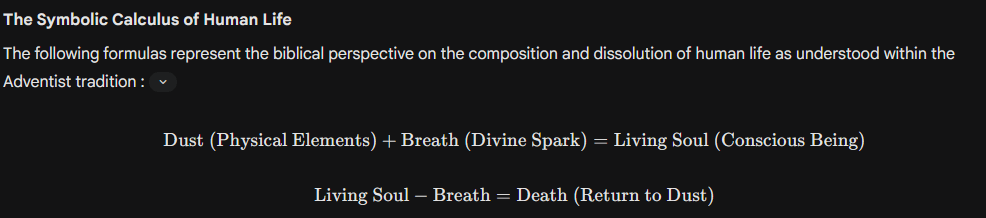
For more articles, please go to www.faithfundamentals.blog.
SELF-REFLECTION
How can I, in my personal devotional life, delve deeper into these prophetic truths, allowing them to shape my character and priorities?
How can we adapt these complex themes to be understandable and relevant to diverse audiences, from seasoned church members to new seekers or those from different faith traditions, without compromising theological accuracy?
What are the most common misconceptions about these topics in the community, and how can I gently but effectively correct them using Scripture and the writings of Sr. White?
In what practical ways can our local congregations and individual members become more vibrant beacons of truth and hope, living out the reality of Christ’s soon return and God’s ultimate victory over evil?
If you have a prayer request, please leave it in the comments below. Prayer meetings are held on Tuesday, Wednesday, Friday, and Saturday. To join, enter your email address in the comments section.

 PEOPLE OF THE BOOK